
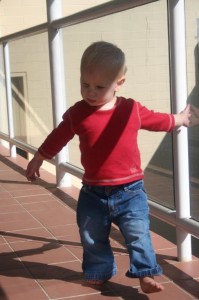
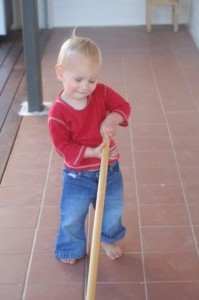

Orientation is the ability to understand where you are in space, whislt mobility is the ablity to get through space. Orientation and Mobility specialists (O&M) work with people who are blind to assist them to understand their position in space and to navigate through it.
Orientation and Mobility Technology
The cane and the Guide dog are the most well known orientation and mobility tools by the general public. However, there are many other devices on the market that may provide as good as, or better, mobility for people with vision impairment. Vision Australia and Guide Dogs are a great source for Orientation and Mobility and provide great fact sheets that are useful to support people with vision impairment.
Mobility Cane:
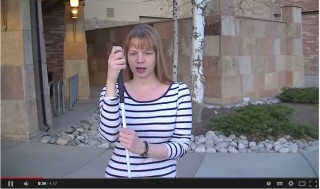 The white cane is primarily used as a mobility tool to detect objects in the path of the user. White canes are available only to people who are legally blind as the cane a symbol of blindness, used to alert others of the person’s vision impairment. Canes are made from aluminium, graphite-reinforced plastic or other fibre-reinforced plastic, and can come with a wide variety of tips depending upon user preference.
Suppliers: Eligible clients are entitled to one free can per year from O&M specialists at Vision Australia or Guide Dogs.
Electronic Travel Aide:
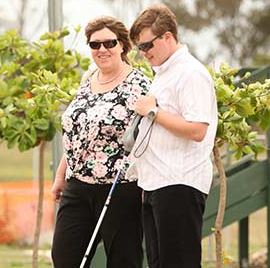 The Electronic Travel Aide, known as an UltraCane is based on the traditional white cane, but includes a “dual-range, narrowbeam ultrasound system that provides a 100% hazard protection envelope in front of and, uniquely, forward of the head and chest of the user” (Sound Foresight Technology, 2014,p.1). This gives users information about potential hazards such as overhanging branches and billboards. To find out more about the UltraCane works visit Sound Foresight, or read the User Guide .
Suppliers: Guide Dogs, Independent Living Centre AUD$1080.
Guide Dogs:
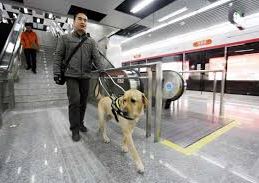 Guide dogs or Seeing eye dogs are trained to take people with vision impairments around obstacles. Guide dogs can not read signs or understand where to go, so the owner has to direct, based on their understanding of where they are in space. “The handler might be likened to an aircraft’s navigator, who must know how to get from one place to another, and the dog is the pilot, who gets them there safely” . Puppies cost over AUD$20,000 to raise and rely on fundraising events by Guide Dogs and Vision Australia to provide Guide Dogs at no cost for clients with no or low vision.
Suppliers: Guide Dogs and Vision Australia
Echolocation:
 Human echolocation is an “ability of humans to detect objects in their environment by sensing echoes from those objects. By illuminating the environment with flashes of sound, people trained to orient by echolocation can interpret the sound waves reflected by nearby objects and accurately identifying their location and size” (D.Kish, personal communication, April 6, 2014). For more information contact World Access for the Blind (Australia).
Talking GPS:
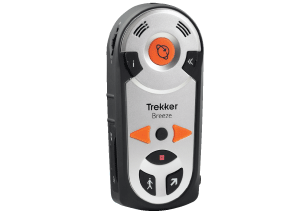
Trekker GPS has voice output which announces names of streets, intersections and landmarks. Available from Humanware. It also enables clients to record routes when with a sighted guide.
Devices of the Future:
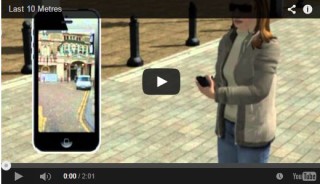
‘Eye tea’ was also very interested in the ‘last 10 metres app’ that won the 2013 London Digital Inclusion Innovation Contest, along with a large grant. The last 10 metres aims to be a low cost smart phone app that uses optimised image process routines, alongside an auditory satellite navigation system to recognise and map land features and buildings (Milner, 2013).
The eye cane is also a tool for the future.
For more information and advice on any Orientation and mobility device, please see a trained Orientation and Mobility specialist at Royal Institute for Deaf and Blind Children, Guide Dogs or Vision Australia.
References:
Milner, J. (18th February, 2013). Satnav for the blind: Guiding your every step. Retrieved from http://www.humansinvent.com/#!/10918/satnav-for-the-blind-guiding-your-every-step/
Sound Foresight Technology. (2014). UltraCane. from http://www.ultracane.com/
Stone, J. (1999). Learning to be Independent. In C. Arter (Ed.), Children with Visual Impairment in Mainstream Settings. Retrieved from http://newcastle.eblib.com.ezproxy.newcastle.edu.au/patron/FullRecord.aspx?p=1273244.